It’s the start of a new year and you probably have some ideas you want to implement into your garden or backyard space. Recently, a friend moved out of state and like any good parent, she brought her pets and her chickens along. But because her neighbors’ fence was damaged and she had neighbors that weren’t too pleased with her flock, she was reported to the police. The police gently reminded her what to do to keep the peace and out of trouble. This event reminded me of all the small things that can happen while not intending anything foul.
I live in a residential home and it is owned by us. The house and land is ours (and the bank) but there were several things I had to consider before I put things in and around our house. I would still have to follow state, county, or city rules regarding the use of greywater, keeping farm animals, and maintenance of my lawn and garden.
Collection of greywater is allowed where I live. I started with two water barrels and hid them at back of our house. I didn’t find any regulations at the time and there was a municipal water barrel rebate which told me that it was acceptable to have rain barrels. But since this was before the recent droughts even started (about 15 years ago) and people here were unfamiliar with water barrels, I kept it hidden so no neighbors would question it. Through the years, I have added more barrels as money and property allowed to a total of 7 barrels. I placed the very last two at the front of the house and by then, the drought was in full force and people off the streets were remarking at my water saving skills. Little do they realize how many barrels I had.
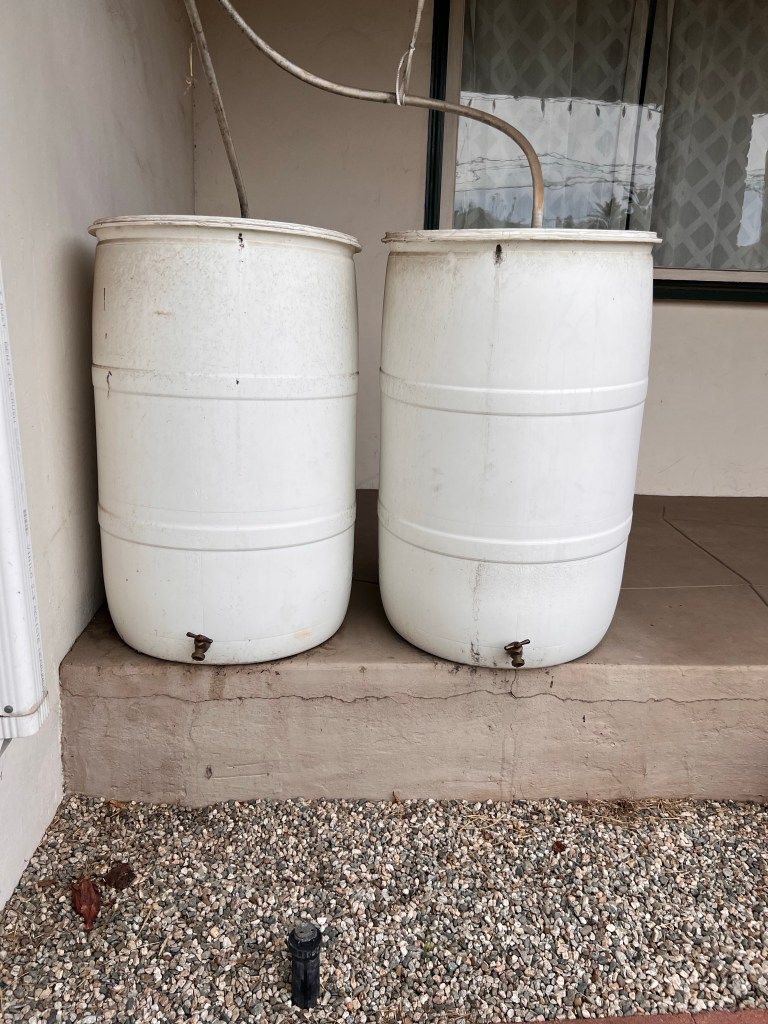
Another way I wanted to save greywater was to reuse laundry water. This became more complicated. Luckily, our local water agency had seminars on how to do this. There are several regulations while doing this and going through a seminar would probably be where I would start. Reading the regulations, it is important to note that this water can only be used on landscape plants and must be hidden under 2″ of mulch. I probably wouldn’t step up the system to reuse my laundry greywater because everything on our property is NOT a landscape plant (except for the succulents). Our trees are all fruit trees. Speaking of trees, there is an ordinance in my city regarding removal of trees of a certain size. This is just another example of things that are regulated without you even knowing its regulated.
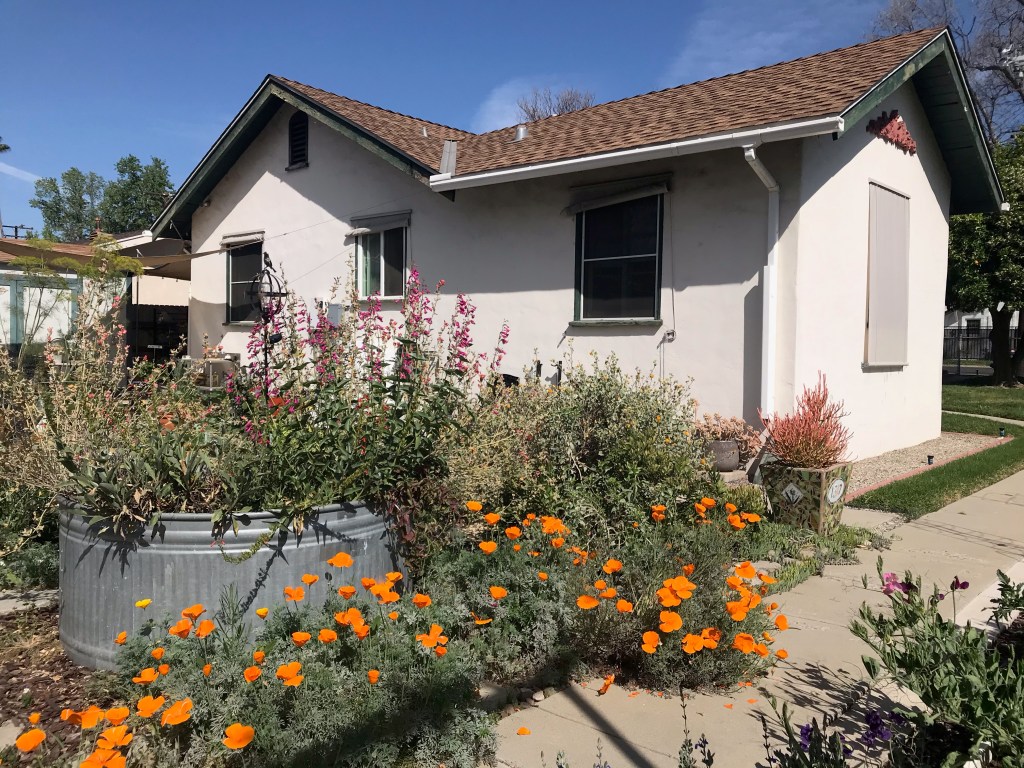
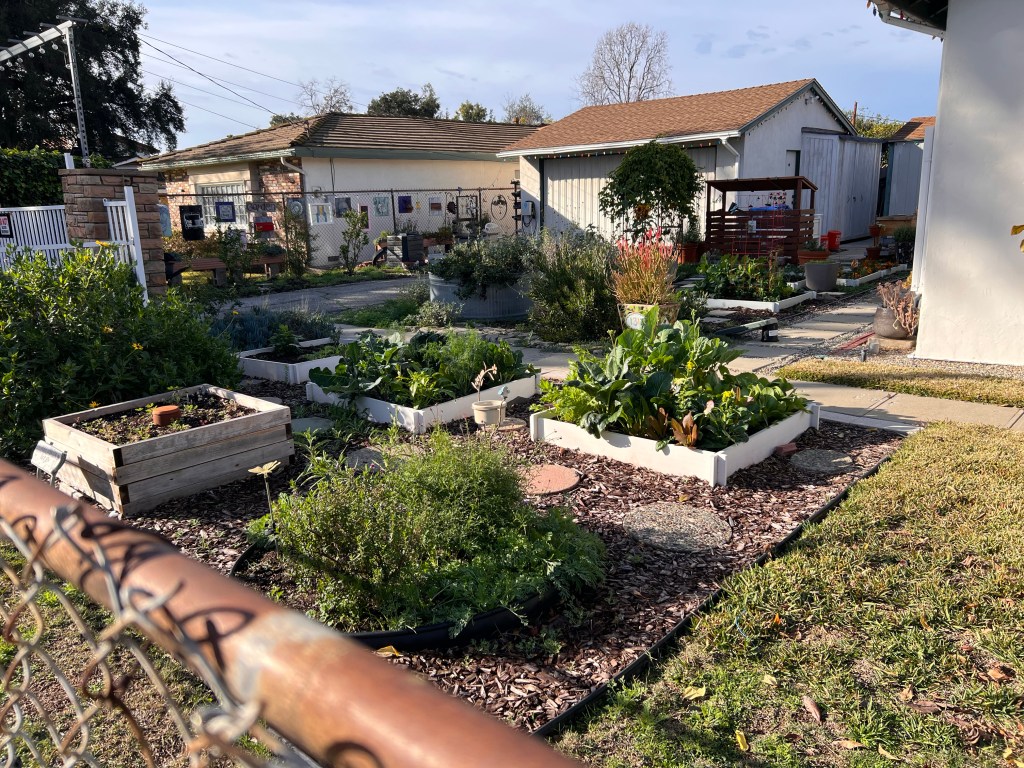
Luckily for me, there is no rule concerning front yard use except for new house builds where it is required to have some native landscaping. This means for a single residence like mine, I can plant a front yard that is an edible garden. I have no green space for my backyard, I have only a front and side yard. I have converted my side yard into a garden and a portion of my front yard as well. Because neighbors can still call in with complaints of a untidy front yard, I tried to incorporate a native landscaping with my edible garden to keep the garden pretty and have a landscaped look.
For those of you in a Homeowner’s Association (HOA), you will have to follow up with your tenancy rules. Some HOAs may not allow you to alter your front yard while your backyard is allowed. Type of plants should be reviewed to verify that they are acceptable (such as invasive plants like bamboo). For some of you, you may live in an area where they do not allow you to have anything but a landscaped front yard with lawn and shrubs and no edible gardens even at single residence homes that you own. Congratulations to you if you have the will to contest this in city council to change the rules. I know things have changed in the past decade and edible gardens in your front yard have become more acceptable. Just be sure to check before planting.
I know that some people enjoy keeping chickens. After reading several books about chickens, I realized that it’s not something for me (though I have fantasies about having a duck and quail). My city only allows 10 domestic fowl and the animal building must be kept 35 feet from any buildings nor are they allowed to be illuminated from 10pm-6am. This is an example of details that could be overlooked. And if I wanted to keep any quail, the native California quails are considered wildlife and cannot be kept, but domesticated ones require a permit.
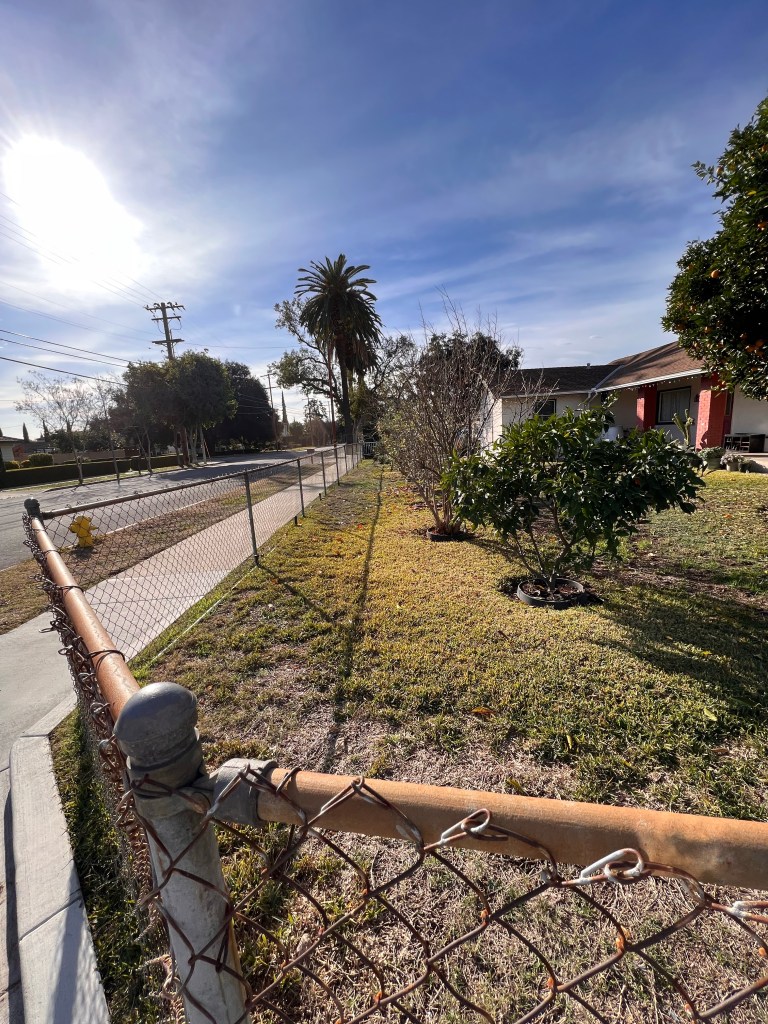
As I’m researching this post, I just ran across a municipal code regarding permanent canopies not allowed in my city. We have a few shade sails so this rule really peaked my interest. And don’t forget to check your regulation on fences. I planted my trees back several feet because if we were to install a new fence, I would have to install it further back than where my current fence is. Our current chainlink fence is old and was installed before this rule took place.
And finally, a recent development concerns the state’s approach to monarch butterfly rearing. From the “California law (Fish and Game Section 1002) prohibits the take or possession of wildlife for scientific research, education, or propagation purposes without a valid Scientific Collection Permit (SCP) issued by CDFW. This applies to handling monarchs, removing them from the wild, or otherwise taking them for scientific or propagation purposes, including captive rearing. ” (from https://wildlife.ca.gov/Conservation/Invertebrates/Monarch-Butterfly). This means those well-meaning people who were rearing monarch butterflies to keep the population up, may no longer rear monarch butterflies. Keep in mind that this rule only applies to monarchs and not to other species of butterflies.
I hope these examples help illuminate some issues you may come across when you’re unintentionally going about planning your garden and outside space. My purpose for this post is not to question the codes (you’re talking to someone who got a ticket for parking in her own property) but to be aware of them and to avoid problems in the future.
I used this link to view my city’s code: https://library.municode.com. If you don’t find yours listed, visit your local library or city hall for your municipal codes.
Another handy link is the California Department of Fish and Wildlife: https://wildlife.ca.gov or your state’s wildlife website.
 635 Gardening