Author: Williams, Wendy, 2020, Simon & Schuster
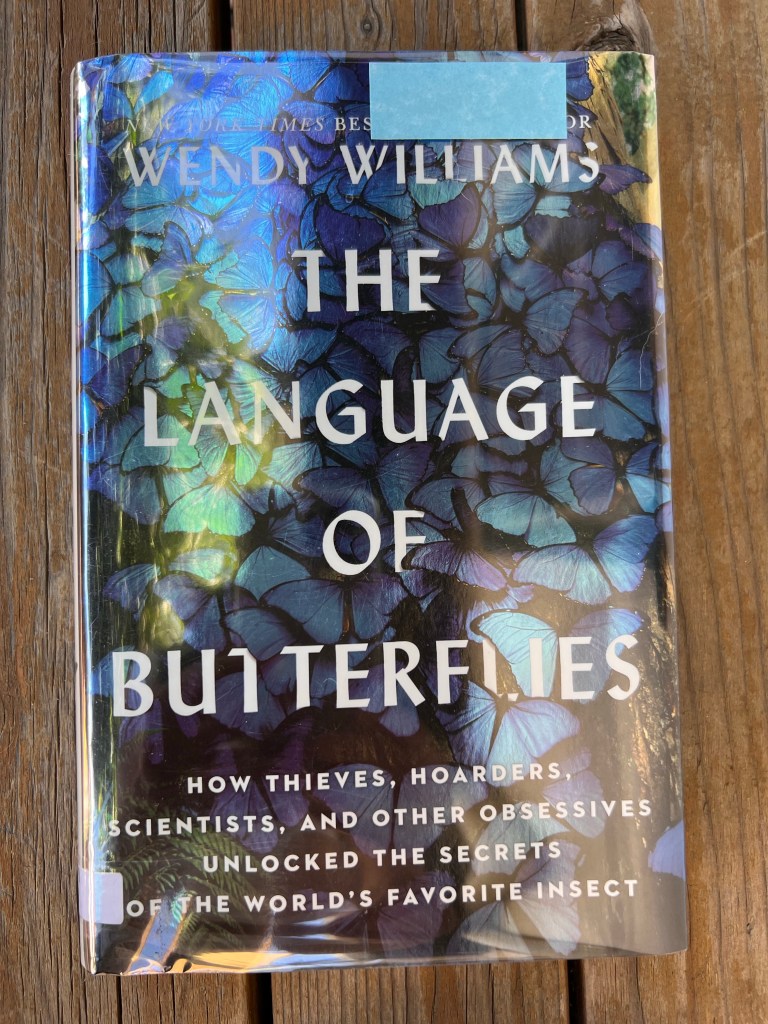
The cover is of a mass of shiny blue Morpho butterflies glistening like some kind of 3D puzzle. The title of this book uses the word “language” and makes you wonder which type of language butterflies are speaking. The subtitle makes it sound like some sort of true crime with thieves and other obsessives. In actuality, this book unlocks the mystery behind butterflies as the hoarders, obsessives, and scientists make these discoveries throughout history.
I thoroughly enjoyed Wendy Williams’ writing, written with a story in mind and often adding some colloquial banter. I added this to my review because I have read reviews by other readers that don’t seem to consider this a science book if it isn’t written in a scientific style. Williams interviews many scientists in the field especially on the current information on Monarch butterflies.
There is so much about the composition of butterflies that was new to me, the proboscis acting like a sponge, the scales on a butterfly wing like gyroids which are a “crystalline three-dimensional structures that allowed for the almost infinite flow of energy,” and the ability of butterflies to mimic other butterflies.
The author introduces us to Maria Sibylla Merian, a 17th century an artist and a keen observer of the natural world especially butterflies. It was she who discovered that butterflies did not spontaneously emerge from dirt. She documented the many different life cycles of the insect as well as the many different varieties which emerged and the plant life that each preferred.
More than half of the book is concerning monarchs. Newly discovered research due to butterfly tagging has scientists able to confidently observe the generation of butterfly that migrates. This opens up new avenues of research including what conditions make them migrate, why don’t all monarchs migrate, what helps them fly such long distances. Williams interviews scientists who are currently researching these issues.
The most important inclusion that Williams made is by discussing the “Fender’s blue” which is a small blue butterfly species endemic in the Willamette Valley. The species was declared extinct in Oregon but an accidental discovery of this butterfly in a more secluded field and the lupines as its host plant and violets as its nectar plant. In order for the lupine seeds to grow, it would need a fire to release the seeds. This sets up the stage for understanding the life conditions and the inclusive natural world it lives in.
[On a personal note, I have visited several areas around California that have repeatedly noted small blue species of butterflies. I always thought they were similar, indeed, they are but each region has their own specific variety. The El Segundo Blue Butterfly is an endangered butterfly near the Los Angeles International Airport (LAX).]
There is still so much left to learn about butterflies and Williams brings you along in her storytelling and left me in awe about what they can do and how little we know.
 635 Gardening