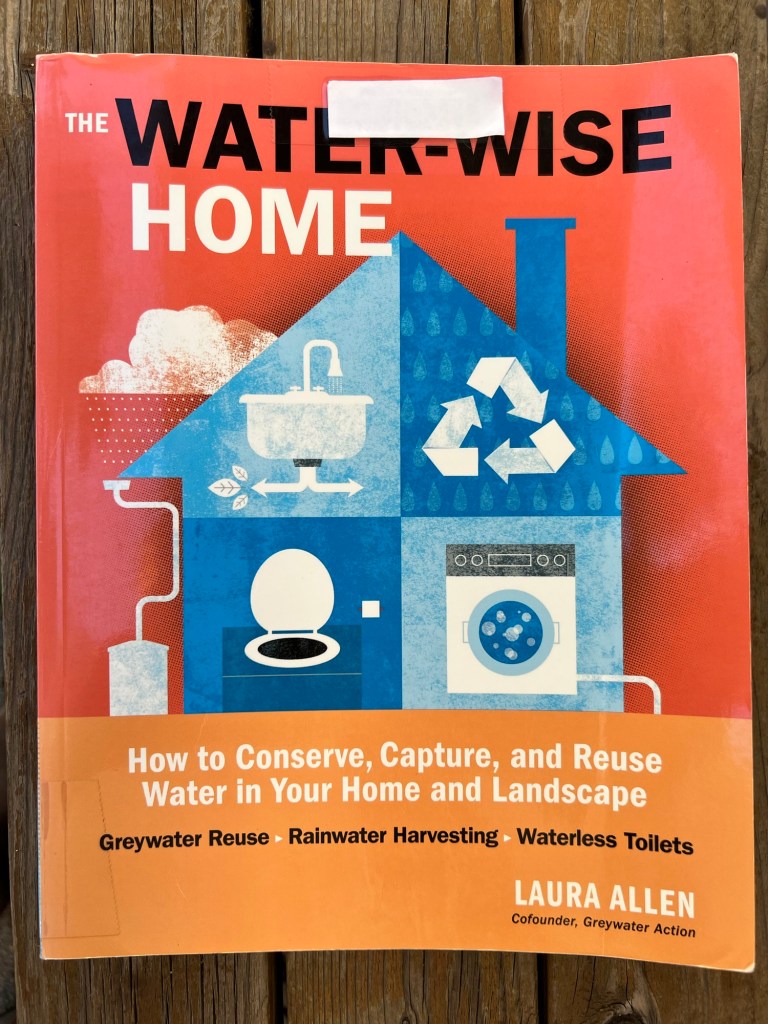
Author: Allen, Laura
Publisher: Storey Publishing, 2015
One of my resolutions for the new year is to be more water-wise. Being water-wise could mean conserving water, utilizing water more efficiently, and reusing greywater. As someone who already owns seven 50 gallon water barrels, uses olla pots to water plants, and composts, the “Water-Wise Home” was a good guide to find more ways in which I can deepen my conservation efforts.
While it is easy to turn the tap for running water, this book wanted the reader to think about how that water came about. It came about through a process that relies on the rainfall and efforts were made to filter it and bring it to your home. And depending on the rainfall for that year, the availability may be minimal. The conservation of water has benefits, from avoiding a shortfall of clean water to saving money.
Along with the unpredictable nature of the environment these days, many of us are facing severe droughts. That unpredictable nature also leads to fierce weather patterns of floods. Allen writes “droughts reduce the water supply while floods contaminate it.” By strengthening your home to be more water-wise, you can become more self-sufficient and not flood your area and have less of a need to depend entirely on the city’s water supply.
Allen lays out several approaches in her book. She discusses landscaping that uses less water by adapting to your climate, to creating rain gardens that absorbs the rain into the soil (as opposed to concrete run-off), and installing graywater systems. Rainwater harvesting through rain barrels and containers are also discussed along with roof water collection and diverting and channeling. There is even the discussion of the various waterless toilets such as dry composting toilets.
Greywater and blackwater is clearly defined with greywater being gently used water and blackwater being contaminated with bacteria such as that from your toilet. There are several plans in this book which detail how to to set up graywater systems from your laundry, your kitchen sink, and showers and baths. She discusses several factors to consider from the distribution of the graywater to the type of plants that get watered.
This book has a thorough account of ways in which you can save and or reuse water. The tone of the book is written in a helpful manner with an understanding that not all of the plans or suggestions may be what you’re wanting to adapt and you may only want to complete a few of these tasks. Whichever plan of action you decide to take, however, it is outlined for you and you will be informed of the things you need to know or have in mind.
After reading this book, there were definitely some questions I had that were answered such as how to hook up multiple barrels and in which position they would be best. I also learned about the composting toilet which seems just as useful for camping situations, and also how to divert my gutters for a rain garden and effective path should run. I would like to implement the laundry greywater system in the future.
I would urge anyone interested in wanting to save water to read this book or at least leaf through and see which situations you can adapt for your home.
 635 Gardening