by Bearzi, Maddalena
Published by Heyday Books, 2023.
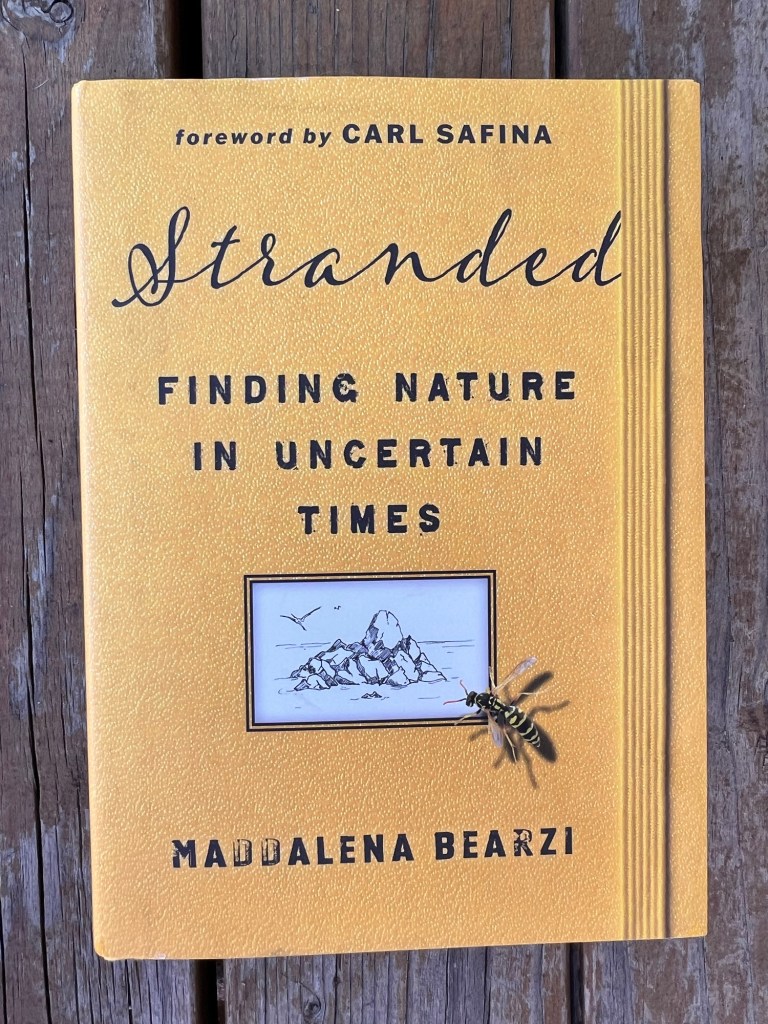
“Stranded” was written during Covid-19 times in 2020, while California was in lockdown and people were told not to go to work. Bearzi, a field marine biologist off the Los Angeles coast, was told to stay at home away from her colleagues and ocean work. Not straying from being a scientist, Bearzi focuses her attention on the wildlife near her home. As a result, “Stranded” will have you thinking on the mundane, familiar aspects of your surroundings with a new perspective.
Bearzi’s wildlife topics include coyotes, insects, birds, opossums, squirrels, lizards, and her dog Genghis. I have a love-hate (ok, mostly hate) relationship with coyotes but I do take the time to try to understand them and reading her chapter has made me appreciate a scientist’s approach to their behavior in an urban/suburban environment but I still am not convinced. Her claims is that she has never seen a coyote in her neighborhood as they are elusive even while she goes coyote chasing when she is informed of coyote posts through the Nextdoor app. I found her tone on this subject to be playful and almost lacking in seriousness, but perhaps she lives in a less infected neighborhood as some of us often have weekly sightings of multiple coyotes, sometimes in herds of three.
That chapter aside, I really enjoyed her observations of her dog and his behavior. As many of us with pets found our dependance with our pet companions during Covid-19 lockdowns, she applies her skilled eye on her dog. Although I have never kept a dog, I have read several books and I find that her observations are insightful and well-written. She has one chapter exclusively on her dog but he is sprinkled throughout the pages as her constant companion.
I learned something new from this book and that the common brown squirrel is actually an invasive species brought over from Europe many centuries ago. The brown squirrel has adapted well in Southern California. She offers no solutions but the philosophical understanding of how nature works.
There is one chapter here on Bearzi’s garden. While she decides to eradicate a portion of her lawn to create a low-water landscape, she does this with little carbon emissions and little money. Using the Nextdoor app again, she gets free clippings from a neighbor. Her chapter is exciting to read, outlining her thought process and steps to complete it. It evokes more than just an achievement but the purpose many of us who garden–a link to life. While the rest of the book may not be something for any gardener, this chapter, “The Remedial Garden,” is worth seeking out to read.
This book does not directly offer much for gardeners, it is a well-written book about observing your surroundings. Gardeners often use their observational skills to become better gardeners through observation and anticipation and comparisons from season to season, variety to variety. Bearzi’s observations as translated into writing, causes one to contemplate more deeply on your surroundings.
 635 Gardening