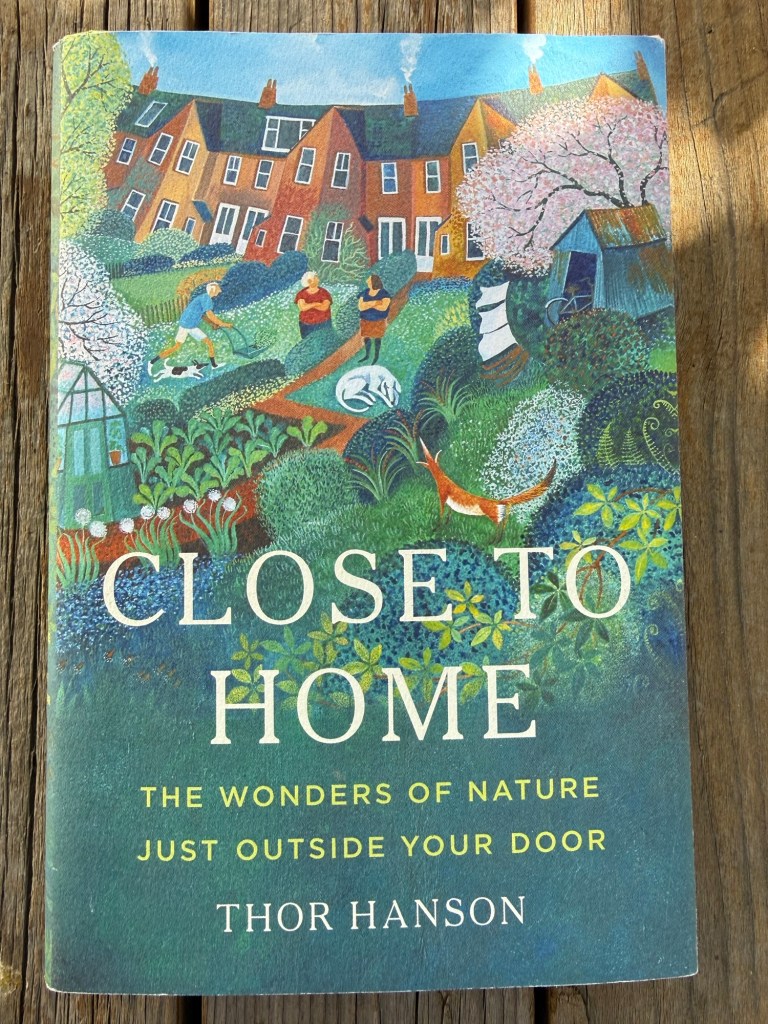
author: Hanson, Thor, published by Basic Books, 2025.
As an environmentalist, there are a few actions I take to participate in lessening my environmental impact: bringing reusable bags to the grocery store, riding public transportation, growing my own food, collecting rainwater, and so on. As the years progress, I find myself getting even further involved, participating in a citizen scientist program called ADAPT to help grow out heirloom seeds and to record my findings to the team at Seed Savers Exchange and the USDA (United States Department of Agriculture). “Close to Home” is a book about taking further action when it comes to observing Nature.
Hanson begins his book by describing his path from his home to his office which lies several steps behind his house (it’s a home office). He notices the birds and their behavior, the color changes of the berry shrubs, and even new growth of ferns and orchids. He also recalls Charles Darwin and how he identified his first species with wild rye grass found in his backyard. These observances have a certain familiarity because they are found at a location he has lived in for decades but his observations and his curiosity is no less diminished.
Without having to ride a vehicle or be flown on a plane, the backyard already holds a lot of nature. Observations can then be included into data as a citizen scientist through programs such as iNaturalist, or other organized participatory programs such as the sunflower and bee project. They can be as involved as an entire season or several weeks of observation for monarch butterflies or as simple as sending a soil sample to a mycology scientist looking for specific bacteria and fungi matter.
Some of these citizen scientists’ submissions have been around for a few years and we are beginning to see results from the data. This book interviews a few scientists and how they have been able to use the data and for the type of research they are conducting. For a few of the scientists, it is just the beginning of something; for others, it is a confirmation of something they have been researching using greater location sources. In some instances, it has led to new “unintended” discoveries, such as a bacterium that helps dissipate odors and could lead to developing a practical use such as eliminating pet odors. In the field of entomology, with so many subspecies insects that have yet to be named, the field is still open for chances in naming an insect after yourself.
I enjoyed reading this book as Hanson weaves his personal stories into his current day observations and endeavors. He describes the smallest details about the forest outside his home office and also in this way, he explains a lot of his thought process and what lead to his scientific observations and conclusions. I found this part to be beneficial as it served as an excellent example of the type of questions a naturalist might ask. As a reader, the writing is descriptive and lures you into its world. This book encourages the reader to participate, no matter how small an act, to engage and further develop and deepen your relationship with Nature.
 635 Gardening