After years and years of a drought, California has been inundated with endless rain. The total so far in my area of Southern California, the San Gabriel Valley, has had close to 30 inches of rain. I haven’t done much to the garden except to reseed lettuce in my standing raised garden beds. I’m not really planning for spring, just jumping into summer vegetables. As I scale back at gardening, I am allowing myself time these next few months to visit the wildflower areas. Here’s a recap and some musings of some of my visits.
Ordinarily, I would prefer experiencing the outdoors but because of Covid-19 and so many shutdowns, my horizons were broadened with even more outdoor adventures. The past few years, my husband and I would check the AllTrails app and try to accomplish some easy hikes on a monthly basis. I was never a hiker, not a fan of strenuous uphill and leapfrogging over uneven ground, and my husband has injuries to his knees. I do love to walk so we have been training ourselves by exploring easy walks and exploring our neighborhoods. We found some wonderful nearly suburban hikes and soon expanded to include exploring potential wildflower sites for future spectacular blooms. Little did we realize that was going to happen in 2023!
Our first visit happened in Chino Hills State Park on February 18. We were here a year ago and I found the Bane Canyon Trail to be hilly and a bit hard on the knees as well as being extra busy with lots and lots of people. We decided to approach the trail differently and go from behind. This turned out to be a masterful plan–instead of hiking up several small hills, we hiked up one big moderately steep hill and reached towards the end of the Bane Canyon Trail where wildflowers were congregated. This was such a pleasant hike with seeing only 5 people during the first half of the trail. The second part of the trail required much patience.

Even if we had arrived at this state park early in the season, some of the poppies have already been crushed. It was extremely heartbreaking. This lead to probably one of the biggest issues I will face in wildflower viewing–when will my tolerance run thin? We had just barely begun and I was already seething. I don’t deny that everyone has a chance, just like me, to view the flowers. And really the people at fault are the first people who trampled over the flowers, but for others to not take a step back and say “this is wrong” and leave the flowers alone or to even think that they might spring themselves back alive or regenerate in the future weeks as more rain happens, is human folly.
Our next visit was at Huntington Beach, the Harriet Weidner Regional Park, on March 4. This was a surprise visit as we were heading to Bolsa Chica Ecological Reserve but came across this park instead. I saw the thicket of yellow and we decided to spend a few hours here. Near the shore, it is a regional park with a children’s playground, rest area, and picnic benches, but also attached is its native park which at this day’s bloom was coastal sagebrush, brittle brush, coast sunflower, and fiddle necks.
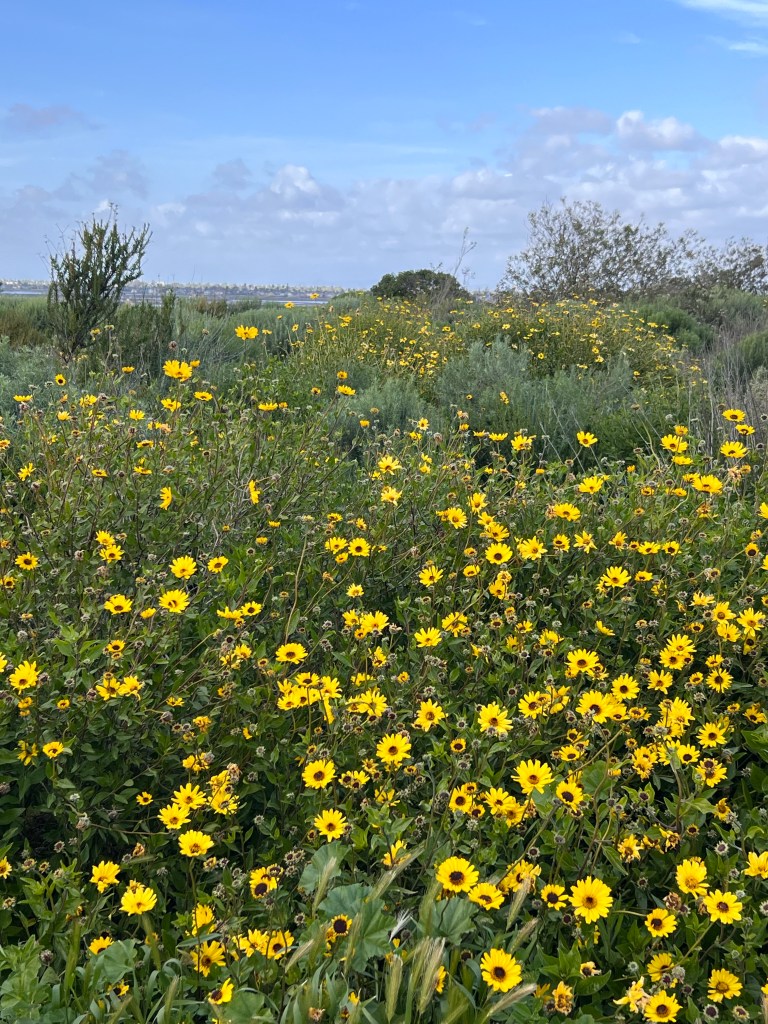
This is a perfect example of how our area parks often have native plants and wildflowers but is overlooked.
Our visit in 2017 of the Harford Springs Preserve, left such an impression that we highly anticipated returning to this location during a fabulous bloom. We probably arrived a few weeks earlier then the peak bloom but with upcoming visits to other areas of SoCal, we wanted to make sure it did not get overlooked. We chose a different way to get to Perris as the last time we came it felt like we were in no man’s land. I actually found a route by going to Riverside and the California Citrus State Park and heading South for about 15 minutes. It felt like a shorter route and we had brunch at a wonderful diner in Riverside.

What makes Harford Springs Preserve so special? There are fewer people here, people who stay on the trails, and probably people who also like to feel isolated and surrounded by beautiful nature. While there are poppies, there are also cream cups, goldfields, and lupines, blue bells, the variety is endless. The flowers intermingle like they are friends and as you turn your corners or climb a small hill, each viewpoint leads you to something beautiful. The pictures don’t do it justice, its something you experience.
I should point out that at this point in the month, we are having downpours and the rain is continuing. It has also been cold and there has been a lot of snow. A lot of snow means snowcapped mountains and one of the things I have not anticipated with all the wildflower viewings and picture taking is having snowcapped mountains in the background.
Endless rain also means that it will rain on the weekends and days you have time off. Being flexible is probably the greatest asset you have.
We opted to visit Anza-Borrego Desert State Park in Borrego Springs during a pre-planned short vacation. The drive from our vacation spot was about 2 hours as opposed to 3-4 from Los Angeles and so it seemed like a more feasible visit and it was projected to be sunny that day in the desert while the rest of LA, SD, and Riverside County still had cloudy and/or rainy day.
I have never been to Anza-Borrego and to be honest, it’s such a long drive, I probably won’t in the future, but I was glad the decision was made to go and to go this year. It did not disappoint. Unlike previous years, their bloom usually happens in the winter (which is even earlier than Joshua Tree National Park another desert, North of Borrego Springs) but because of the rain, the bloom was extended and our timing was perfect on March 23.

Sand verbena, desert dandelions, desert primrose, dot the landscape in its yellows and purples. Unlike other parks, they didn’t necessarily have trails and the volunteers at the visitor’s center said it was perfectly fine to walk in between the plants. There was plenty of sand in between but one still had to be careful as some spots had emerging plants or tiny desert flowers often overlooked and discounted because of their size.
I really enjoyed the wildflowers at this Colorado desert and brought back a lot of pleasant memories of searching for wildflowers at Joshua Tree National Park. The “lower” Cottonwood part of JTNP is often where you would find vast areas of blooms which is also the Colorado desert so the two parks share this similarity.
We had to jump at the opening opportunity to visit Diamond Valley Lake in Hemet. This visit was already delayed not once but twice and we wanted to avoid visiting it on a weekend so we went on Friday, March 24. If we went any later, the popularity of this place would grow even more than it already has, and the bloom would have reached its peak. They charge a recreation parking fee as well as a trail use fee but this did not turn away visitors!
For whatever reason, most people walked counterclockwise but we decided to walk clockwise and had for moments, space for ourselves, and was not encumbered by keeping pace with others. With the price of admission, DVL gives you a beautiful wildflower guide and we spotted many flowers during our walk: California Poppy, lupines, goldfields, phacelia, canterbury bells, chia, baby blue eyes, blue dicks, fiddlenecks, tidy tips, and red maids. (This list is similar to what was found at Harford Springs with the exception of the cream cups.)
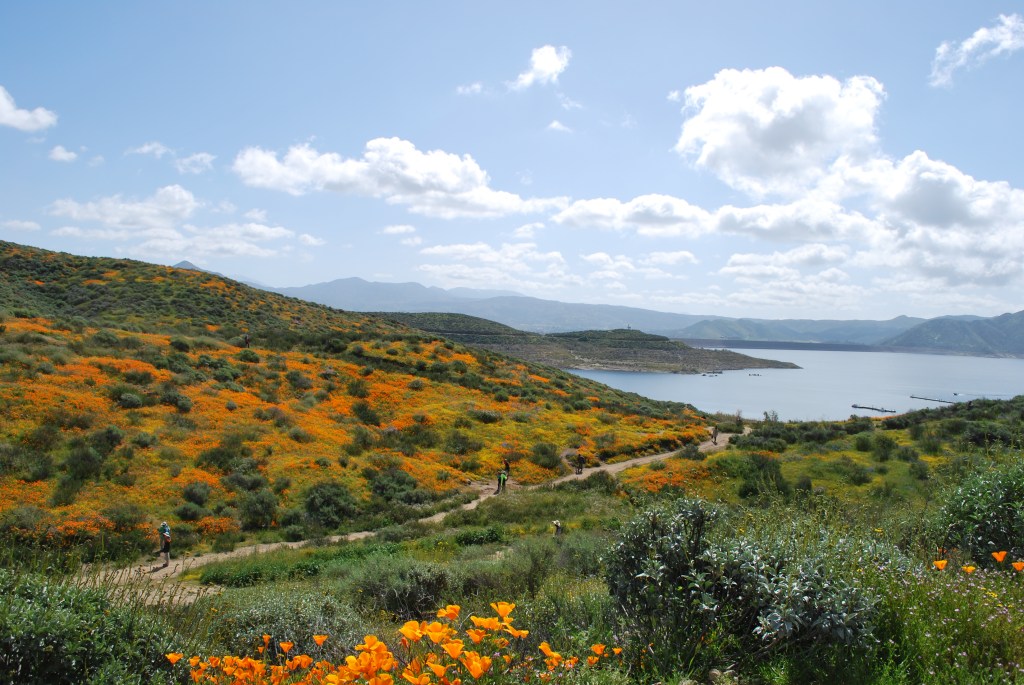
I have to be honest, I preferred this poppy walk over the Antelope Valley Poppy Reserve in Lancaster. It wasn’t as windy, the trail was more interesting and the drive did not feel so remote.
As you may have followed the progression of my visits, the bloom in early Spring were along the Riverside counties East of the 15 freeway, South of the 10 Freeway, near the 74 Highway. This area often gets extremely warm during the summer so it was no surprise it bloomed first. This was also torture for those who could not wait for it to reach their area of NorCal or SLO County or Ventura County. But not to worry, that’s coming up soon.
And because the urban areas of L.A. received a lot of rain, the flowers are still forming and its barely peaking. I know its going to be exciting for the urban areas—I actually saw sunflowers off the Sunflower Road exit by Glendora off the 210 freeway.
I leave you at the end of March, with this snowcapped picture I took at Diamond Valley Lake.
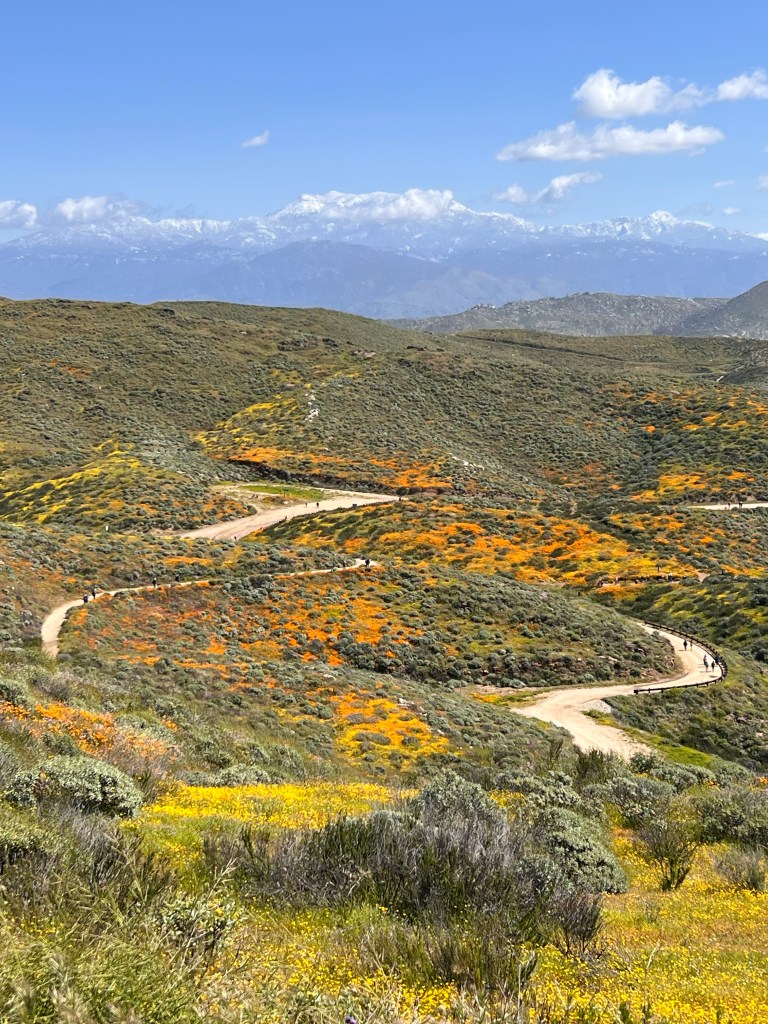
With views this good, we all are a little wildflower crazed right now.
 635 Gardening
Awesome pics, thanks for sharing them
LikeLike