Author: Simon Parkin
Published by: Scribner, 2024.
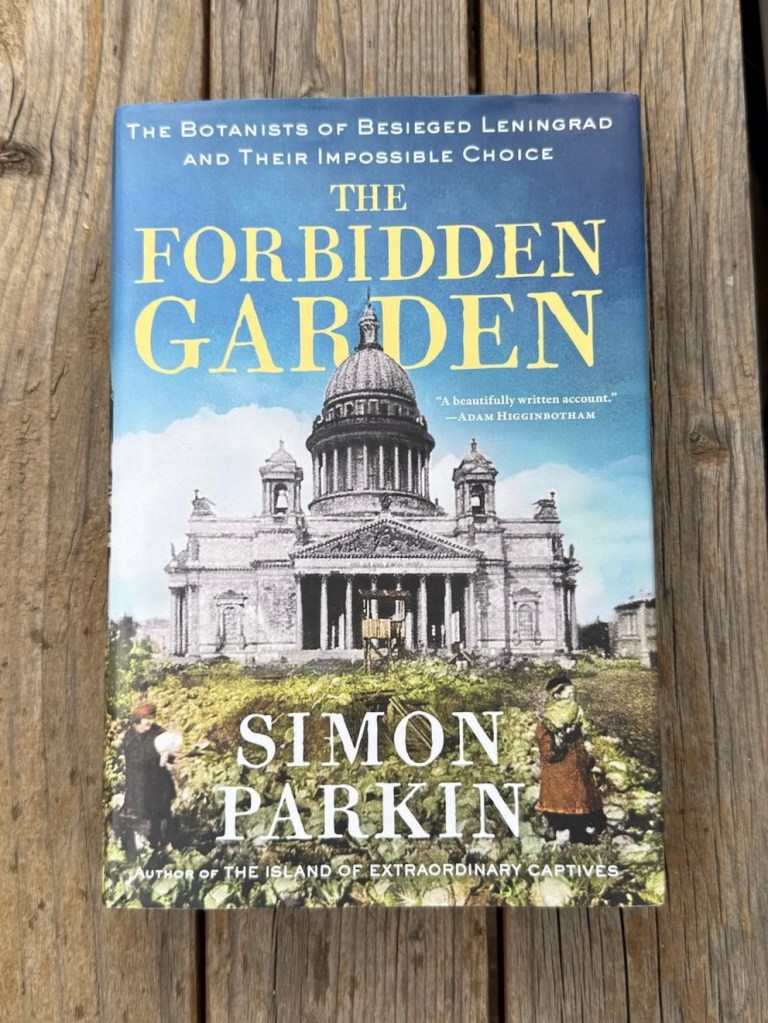
“The Forbidden Garden” reads like a horror novel except it actually happened. Based on reading the synopsis of Simon Parkin’s other non-fiction books, he researches and writes about interesting often overlooked topics when discussing wars. This book is no different. It is set during the Siege of Leningrad (currently St. Petersberg) against Nazi Germany for 872 days in 1941-1944. The events during the siege is told through the lens of botanists who make a bold decision to protect their work.
In describing this book, the biggest flaw would be to describe too much of what the botanists did so I will keep it brief. The Plant Institute, which was led and founded by Nikolai Vavilov, kept seeds to build the largest seed conservation bank of its time. It predates the Svalbard Global Seed Vault by nearly 100 years. Vavilov and his team traveled the world saving seeds, keeping records of the items, with the goal that these seeds could be crossbreed into stronger plants.
While trying to centralize their seeds at the capital, the world sets in on them and the city is sieged by Nazi Germany. Very little of anything, including food, goes into the city and the residents must figure out how to survive. The residents include botanists from the Plant Institute that decide to stay and guard their life’s work. All the employees make a pact and decide that they will not eat any of the seeds. The Institute is located across from the famous Hermitage Museum but neither their work nor their employees are treated with much respect by the Russian government.
Botanists are scattered and located throughout the city based on the seeds they were holding. There were attempts to send seeds safely away. At the Institute, botanists need to keep seeds at the correct temperatures and fight off rats and thieves wanting to break in. They do this while they fight defensively to save their building from bombs and spot fires.
There are brutal harsh winters which affect the population of the city and many die from starvation which is listed as “dystrophy.” The deaths could not accurately be attributed to starvation which skews the data but it is believed half a million to a million people died. I include this information so you are aware while reading this book that this entire tragedy is not lessened by Parkin but is described in detailed for much of the book. If you do not believe you can handle the harsh events, this book may not be for you. Having read “The Boy Who Harnessed the Wind” by William Kamkwamba, the hunger parts of that book was deeply disturbing. This book is even more so.
Parkin tells their story with a deep respect for the botantists and additional empathy for female botanists who often work, keep house, and protection duties from the war. He does an excellent job of telling their story of a time that is heavily chaotic and a time and events that Americans and other people of the world may not understand. I kept referencing reading this story to the images of an art show I saw which had pictures of the Leningrad/St. Petersberg seed vaults and their hands-on, “basic” tools they used, and how it was an extraordinary duty they had done with so very little.
I was also impressed with Parkin’s research and understanding of seeds. He described the temperature and the conditions they needed to be viable seeds. He described how potatoes needed to be grown and cultivated to continue with viability. He stressed the need and importance the work that the botanists were saving while also challenging their decision to save and protect all the seeds. This is a heartbreaking, horror-nightmare story and I appreciate how it is the farmers and gardeners who are often the caretakers of others.
 635 Gardening